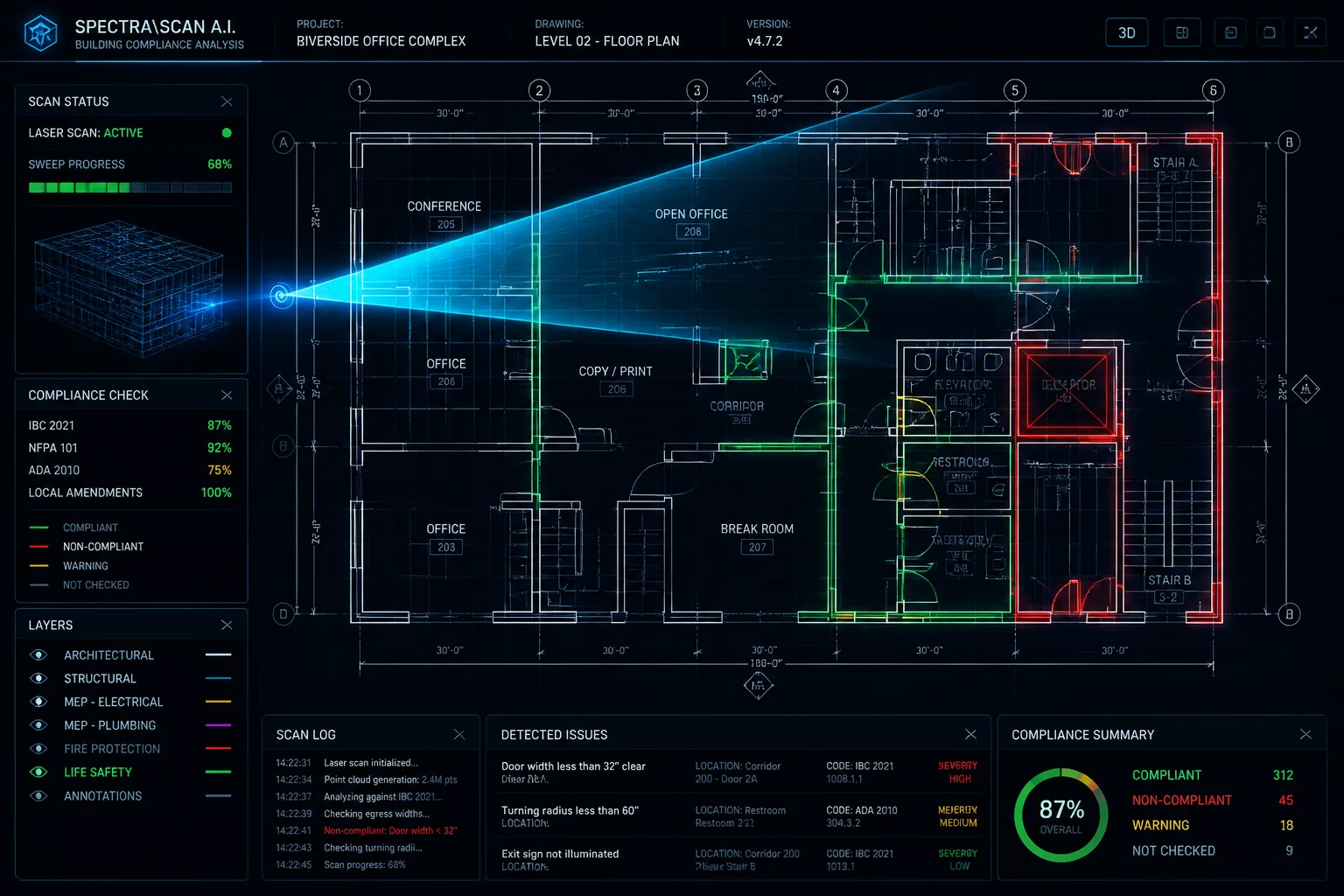
Manual verification of drawing sets against institutional and national standards has long represented one of the most resource-intensive bottlenecks in production pipelines. Automated standards checking in US CAD environments replaces subjective visual spot-checks with deterministic rule engines that parse layer nomenclature, geometric consistency, annotation styles, and plot configurations before files ever reach downstream consultants or agency review desks.
The Architecture of Automated CAD Standards Engines
Standard auditing modules operate by querying drawing databases directly via structured object models rather than relying on viewport interpretations. When an auditor runs an assessment routine, the software systematically evaluates drawing properties against a preconfigured standard definition file (such as DWS in AutoCAD or equivalent schema definitions in competitive suites). These rules define rigid criteria across multiple vector and database attributes:
Layer & Discipline Modifiers
Evaluates layer syntax according to the AIA / National CAD Standard hierarchy (Discipline Code, Major Group, Minor Group, Status Field). Flags non-conforming prefixes, illegal characters, and unauthorized custom layers.
Typography & Dimension Styles
Checks text heights, font mappings, arrow terminations, dimension scale overrides, and non-associative callouts to prevent illegible annotations in plotted deliverables.
Linetypes & Line Weight Mapping
Scans entity property overrides (Color, Linetype, Lineweight) to ensure adherence to ByLayer standards, preserving color-dependent (CTB) and named (STB) plot integrity.
Symbol & Block Nomenclature
Audits nested block structures, duplicate block definitions, unpurged legacy artifacts, and coordinate scale uniformity across repeated schematic symbols.
Batch Auditing and Pre-Flight Validation Pipelines
Modern AEC practices deploy standards verification at several distinct stages of the design timeline. Rather than treating validation as an end-of-phase chore, automated pipelines integrate continuous pre-flight routines into publishing scripts and check-in triggers within cloud project repositories.
Automated batch checking utilities scan multi-sheet packages across dozens of drawing files simultaneously, generating granular XML and HTML non-conformance logs. These reports isolate every violation with object handles, layout references, and recommended remediation paths. Drafters can either execute automated bulk fixes (such as remapping deprecated layers to standardized definitions via layer translator tables) or address complex spatial discrepancies individually before generating client deliverables.
Standardization Frameworks Supported Across the Industry
Automated verification engines are structured to enforce compliance across diverse baseline specifications used across North American federal, municipal, and commercial sectors:
- United States National CAD Standard (NCS): Comprehensive structure covering layer name conventions, drawing set organization, sheet identification, and standard abbreviations.
- AIA CAD Layer Guidelines: Detailed hierarchical formatting for architectural, structural, civil, and MEP disciplines.
- US Army Corps of Engineers (USACE) CAD/BIM Standards: Specialized spatial and data schema requirements for military and infrastructure engineering projects.
- Department of Transportation (DOT) Standards: State-level transport guidelines mandating strict civil alignments, stationing symbology, and custom linestyles.
Continuous Governance and Revision Trail Integration
The intersection of automated CAD standards verification with revision tracking workflows creates an ironclad trail of design evolution. When an amendment or addendum occurs, automated delta tools detect whether modifications introduced rogue layers, exploded geometries, or non-standard dimension overrides alongside visible geometry changes. Maintaining clean schema throughout every delta prevents drawing corruption and simplifies cross-disciplinary federation in both 2D DWG and hybrid 3D BIM coordination platforms.